
 English
 Deutsch
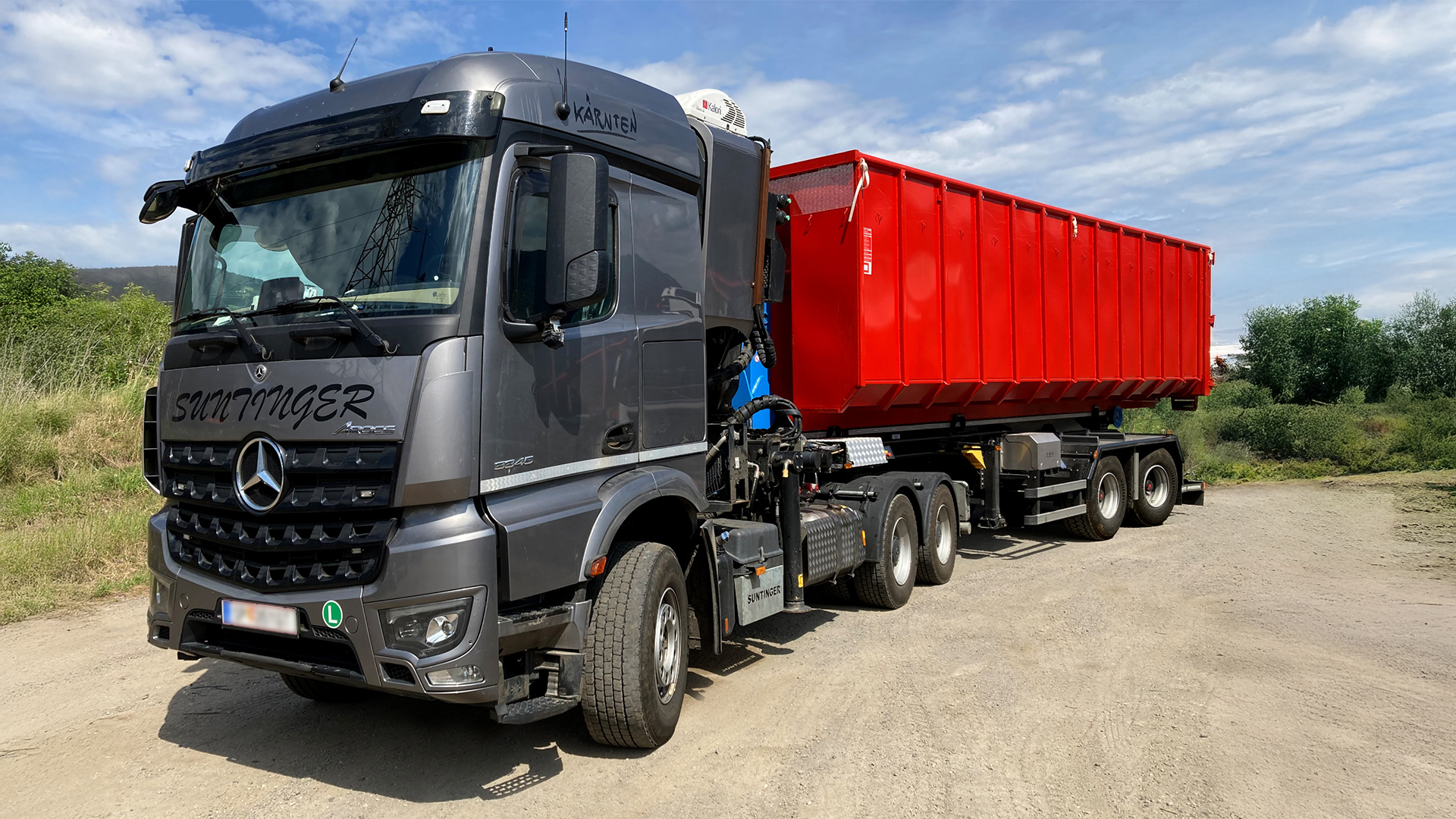
Key Points at a Glance:
- WIESE Fahrzeugbau has developed a special 2-axle roll-off tipper featuring two SAF forced-steering trailer axles for maximum manoeuvrability on narrow forest tracks.
- The forced-steering axles from SAF, combined with the VSE Advanced Steering electro-hydraulic steering system, improve manoeuvrability, reduce tyre wear and increase operational efficiency.
- The vehicle was developed in close collaboration between WIESE Fahrzeugbau, SAF-HOLLAND and the Austrian forestry contractor Johannes Suntinger.
Transporting wood chips from the forest places high demands on the vehicles used. The material is usually produced directly in the forest and then transported to temporary storage sites, where it is dried. A large load capacity and high manoeuvrability are crucial in order to be able to manoeuvre safely even on narrow forest paths and unpaved forest roads.
Against this backdrop, WIESE Fahrzeugbau, in collaboration with SAF-HOLLAND, developed a special vehicle concept for forestry use: a 2-axle tipper with forced-steering, drum-braked axles and the VSE Advanced Steering electro-hydraulic steering system, as well as a specially designed 50 m³ roll-off container.
Unusual axle configuration
The vehicle features three axles on the tractor unit and two forced-steering SAF axles on the trailer – a relatively rare configuration. Whilst conventional semi-trailers are usually fitted with three rigid axles, WIESE specifically opts for forced-steering axles to significantly improve manoeuvrability.
The trailer axles are controlled via the VSE Advanced Steering electro-hydraulic steering system. The system continuously analyses the vehicle’s speed, steering angle and direction of travel, and adjusts the steering movements of the axles in real time.
A key advantage: the solution operates completely independently and requires no additional connection to the tractor unit. This allows the system to be flexibly integrated into various trailer configurations.
Precise steering even when reversing
Unlike self-steering systems – often referred to as the ‘shopping trolley principle’ – the new vehicle features two genuine forced-steering SAF axles. This design enables precise control of the axles when driving both forwards and backwards. The system’s hydraulic pump is mounted directly on the trailer and is powered via a 24-volt connection to the towing vehicle. Optionally, the system can be fitted with maintenance-free batteries that are charged whilst driving. Control is via sensors and programmable software, allowing the steering angle and axle behaviour to be adapted to different vehicle configurations. The system can be combined with axles from various manufacturers and allows axle loads of up to eleven tonnes per steered axle.

Advantages in forestry applications
The practical benefits of trailer steering are particularly evident during demanding operations on forest tracks. Active steering of the trailer axles significantly improves manoeuvrability and makes it easier to manoeuvre on narrow tracks or in confined storage areas.
Further benefits include reduced tyre wear and lower rolling resistance when cornering. The integrated hook lift offers additional flexibility. It enables the rapid dropping and picking up of roll-off containers – even on uneven terrain. This allows the driver to set down a loaded container, immediately pick up an empty one and reduce downtime.
Field test at an Austrian forestry operation
The vehicle was developed in close collaboration between WIESE Fahrzeugbau, SAF-HOLLAND and the Austrian forestry contractor Johannes Suntinger. After around two months of use and some 2,000 kilometres on forest tracks, the verdict is positive. “Many of the tracks here are extremely narrow, and tight bends are often a real problem,” reports Suntinger. “With the two steering axles, the trailer follows the vehicle’s steering movements very precisely. We can get through even on narrow forest tracks without any problems.”

Innovative steering axle for forest tracks, construction sites and city centres
“We see SAF steering technology, combined with VSE Advanced Steering, as a genuine innovation for trailer manufacturers and fleet operators alike. Particularly where manoeuvring space is tight and reversing manoeuvres are the order of the day, the system offers a clear advantage – be it on forest tracks, construction sites or in inner-city scenarios. Furthermore, our customers benefit from lower vehicle weight and thus greater cost-effectiveness,” says Alexandre Charpiot, Vice-President Sales EMEA at SAF-HOLLAND.
Infobox: VSE Advanced Steering
The VSE Advanced Steering system is an electro-hydraulic trailer steering system for the active control of trailer axles. The solution operates independently and requires no mechanical connection to the towing vehicle. Sensors detect the driving conditions and steering angle of the towing vehicle, whereupon an electronic control unit calculates the steering angles of the trailer axles in real time and implements them hydraulically.
- System type: electro-hydraulic trailer steering
- Hydraulic supply: electrically driven pump unit mounted on the trailer
- Power supply: 24-volt connection from the towing vehicle
- Optional: AGM battery system for additional power supply
- Sensors: steering angle and position sensors
- Control: programmable electronic control unit
- System weight: approx. 160 to 470 kg (depending on configuration)
- Forced-steering drum brake axle from SAF
- Axle load: 11 t per forced-steering axle
- Configuration: up to three actively steered axles possible
- High manoeuvrability in tight manoeuvring spaces
- Precise steering even when reversing
- Reduced tyre wear thanks to optimised steering angles
- Less space required compared to mechanical steering linkages
- Flexible integration into various trailer designs
